Online Nikah in Pakistan
Online nikah in Pakistan is a nikah ceremony conducted by video link, in which one or both parties participate remotely while a licensed Nikah Khawan solemnises the marriage in Pakistan with witnesses present.
It is the established route for couples separated by distance — and especially for overseas Pakistanis — but one point must be understood from the outset: a video call alone is not a registered marriage. The ceremony, the Nikah Nama and Union Council registration are separate steps, and all of them matter.
اردو میں پڑھیں— آن لائن نکاح کا طریقہ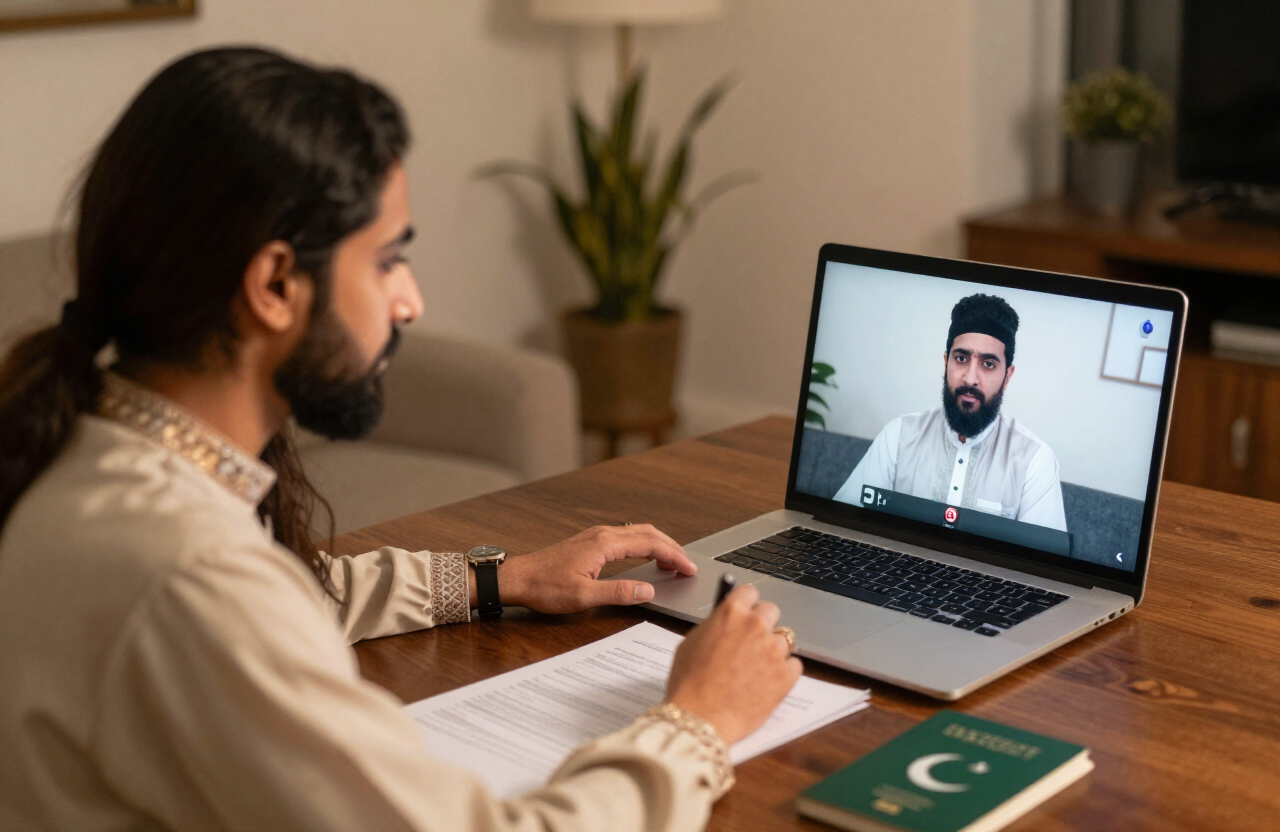
Quick Answer
An online nikah is a genuine nikah conducted by video link: ijab-o-qabool before two witnesses, Haq Mehr recorded, Nikah Nama completed in Pakistan, and registration with the Union Council under the MFLO 1961. Where a party is absent, a wakeel is appointed through a written authorisation. The computerised MRC follows registration.
What Online Nikah Means — and What It Does Not
An online nikah uses video conferencing so that a party in another city or country can participate in the ceremony in real time. The Nikah Khawan, the witnesses and the Nikah Nama are in Pakistan; the remote party sees, hears and answers the ijab-o-qabool live.
What it is not: a video call is not, by itself, a legal marriage. Official recognition comes from the completed Nikah Nama and its registration with the Union Council. Any service marketing a video call as automatic legal registration — without documentation and registration — should be treated with caution.
Is Online Nikah Legal and Islamically Valid?
Pakistani law does not require both parties to stand in the same room; it requires free consent, witnesses, a completed Nikah Nama and registration. Pakistani courts have accepted marriages solemnised with remote participation and representation, provided the essentials were genuinely observed.
On the religious side, many scholars accept a nikah conducted by video link where the ijab-o-qabool is clearly exchanged and heard by the witnesses, and where an absent party is properly represented by a wakeel. Schools of thought differ on details, and we do not issue religious rulings — for a fiqh opinion on your specific arrangement, consult a qualified Islamic scholar.
The Role of the Wakeel (Representative)
Where a party cannot be physically present, a wakeel is appointed in Pakistan through a written authorisation — usually a Special Power of Attorney attested by the Pakistani mission abroad. The wakeel attends the ceremony, confirms the absent party's consent, and signs the Nikah Nama on their behalf. Proper appointment of the wakeel is not a formality; it is what connects the remote party's consent to the physical documents.
Online Nikah Requirements and Documents
The essentials mirror an in-person nikah, adapted for remote participation:
- CNIC or NICOP of both parties (clear scans for verification)
- Passport of any party who is a foreign national or residing abroad
- Two adult Muslim witnesses present with the Nikah Khawan
- Written wakeel authorisation / Special Power of Attorney where a party is represented
- Divorce certificate or death certificate, if previously married
- A stable video connection and a quiet setting for the ceremony
The Online Nikah Procedure Step by Step
- Consultation — we confirm eligibility, time zones and the correct Union Council jurisdiction.
- Document verification — scans are checked for consistency before anything is scheduled.
- Wakeel appointment — the Power of Attorney is prepared, attested and verified where needed.
- Technical rehearsal — a short test call confirms video and audio quality for all participants.
- The ceremony — ijab-o-qabool by video link, witnesses present, Haq Mehr recorded, Nikah Nama signed in Pakistan.
- Registration — the Nikah Nama is registered with the Union Council under the MFLO 1961.
- MRC and delivery — the computerised MRC is collected and couriered internationally with tracking; attestation is arranged where required.
Registration, MRC and Foreign Recognition
After registration, the local authority issues the computerised Marriage Registration Certificate from NADRA-linked records. For use abroad — a UK spouse visa, a UAE residence permit, a US or Canadian sponsorship — you will normally need the MRC, a certified English translation, and MoFA attestation, with embassy legalisation for some destinations.
A properly documented Pakistani marriage is generally recognised abroad, but every country applies its own immigration and civil-recognition rules, and no private company can guarantee a foreign authority's decision. We prepare the document set correctly; the decision always rests with the foreign authority.
Time and Fees for Online Nikah
The ceremony itself takes under an hour once documents are verified; the full matter — verification, wakeel arrangements, ceremony, registration and MRC — typically runs from several days to two weeks, with attestation and courier adding time for overseas clients. Fees depend on scope: representation, attestation and courier all affect the quotation. Contact us for a current, itemised fee.
Frequently Asked Questions
Related Guides
Speak to Our Matrimonial Legal Team
Confidential consultation for court marriage, online nikah and marriage registration anywhere in Pakistan. No obligation — just clear legal guidance.
T-219, Supreme Corner, Block 18, Johar Chowrangi, Gulistan-e-Johar, Karachi